Bunny Kick: The Science Behind Your Cat's Rabbit Style Kick
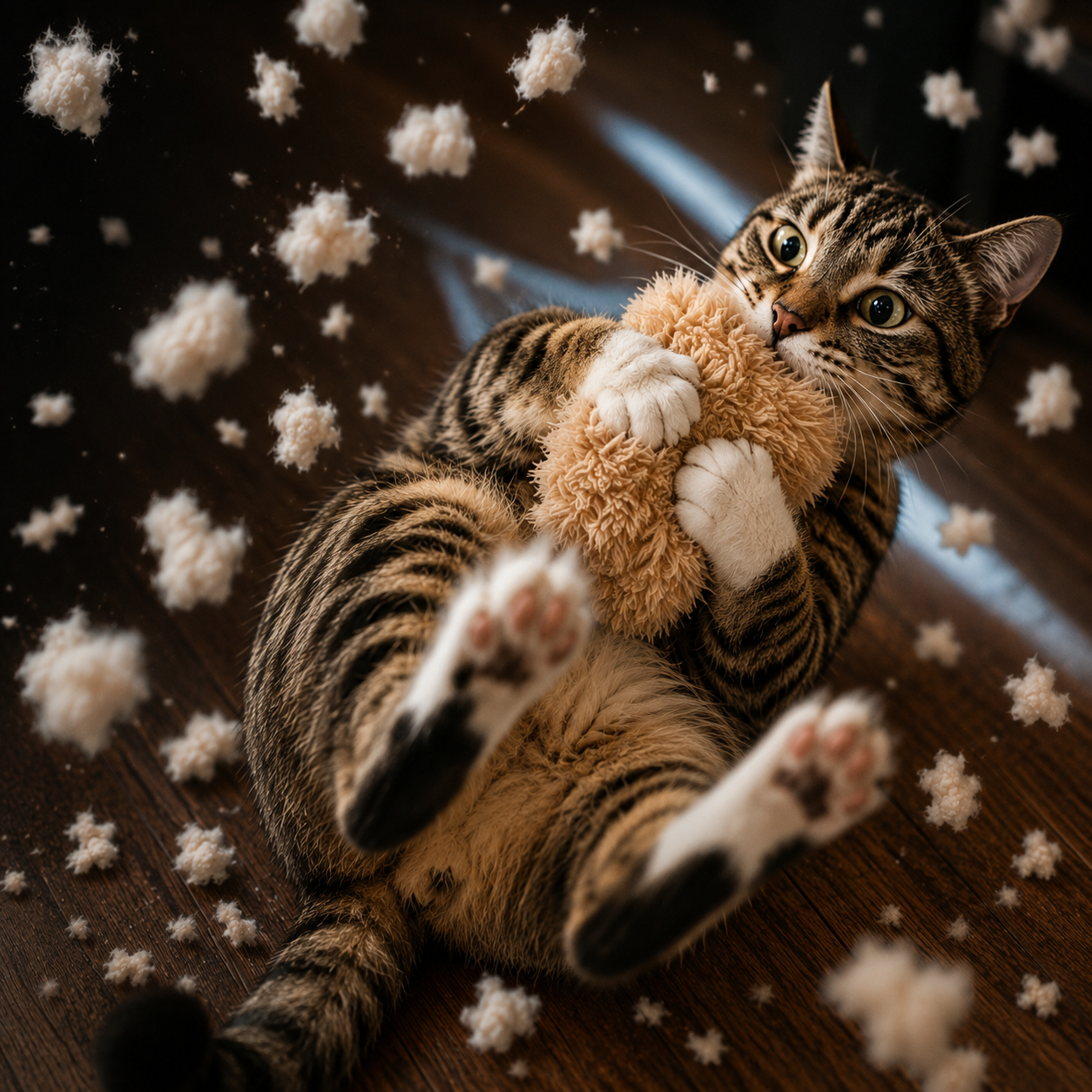
You were petting your cat's belly and suddenly got kicked. The hind legs fired off a rapid burst of strikes, maybe while the front paws clamped around your arm. This behavior has a name: the bunny kick. Far from being bad temper or spite, it is one of the oldest and best documented behaviors in the feline repertoire.
What the bunny kick actually is
The bunny kick is a motor pattern in which the cat lies on its side or back, grabs a target with its front paws (a toy, an arm, another cat) and delivers a rapid series of powerful kicks with the hind legs, usually together. It appears in kittens, adult domestic cats, and also in larger wild felines, including lions and tigers.
Where the movement comes from: the predatory sequence
To understand the bunny kick, look at the anatomy of feline hunting. Ethologist Paul Leyhausen, in his classic monograph on the predatory and social behavior of domestic and wild cats, described in detail how the front paws grip and hold prey while the hind legs disable and injure the target. That division of labor between front and back paws is exactly what we see when a domestic cat bunny kicks a plush toy. The target has changed, but the underlying neural circuit has not.
Research compiled in major academic reviews on the biology of domestic cat behavior shows that kittens begin practicing this sequence at a very young age, in what looks to us like simple play. In practice, this object play works as motor rehearsal for the hunting skills the adult cat may eventually need.
When the bunny kick is defense
There is a second context in which the bunny kick appears: defense. If a cat is turned onto its back and feels threatened, its belly becomes exposed, a vulnerable area. The instinctive response is to fire the hind legs at full force, claws out, to push the threat away as quickly as possible.
The difference between a playful bunny kick and a defensive one lies in intensity and body context. In play mode, the kicks tend to be more restrained, the ears stay forward, and there is no real biting pressure. In defense mode, the force is maximal, the ears flatten against the head, the pupils dilate fully, and the claws are fully extended.
Enter the primordial pouch
That swaying fold of skin and fur on a cat's belly, known as the primordial pouch, is part of this same story. It acts as extra protection for the internal organs in exactly the region most exposed during a bunny kick, whether the cat is delivering the kick or receiving one from another animal in a dispute. Lions and tigers have the same structure, which reinforces its evolutionary, not cosmetic, role.
Belly rubs and the overstimulation threshold
One of the most common moments tutors receive a bunny kick is during a belly rub. The cat is lying relaxed, showing its belly because it feels safe. Feline behavior experts point out that, contrary to popular belief, an exposed belly is not an automatic invitation to touch. It is a sign of trust, but prolonged touching can quickly tip into overstimulation.
When that happens, the cat signals its limit the only way its nervous system knows how: grabbing the hand or arm with its front paws and firing off the bunny kick. This is not lack of affection, and it is not "crazy" behavior. It is communication.
Reading the signs before the kick
Several cues can help predict a bunny kick before it happens. A tail beginning to flick, ears shifting position, dilating pupils, and a slight stiffening of the body usually appear seconds beforehand. Recognizing these signs allows you to stop the stimulation in time, before the cat needs to "warn" you more forcefully.
What to do with this instinct
Feline behavior experts, including consultants with decades of clinical experience in behavior modification, agree on one point: the bunny kick should not be eliminated, because doing so is both impossible and unnecessary. The right approach is to redirect this instinct toward appropriate targets.
Long, soft toys known as kick toys are designed specifically to be grabbed by the front paws and kicked by the hind legs. Offering this kind of toy regularly, watching for overstimulation cues during petting sessions, and never using hands or feet as "toys" are the three most effective measures to keep this instinct satisfied without anyone getting scratched.
In short
The bunny kick is not bad temper, it is not malice, and it is not a sign of a "problem cat". It is a motor pattern with thousands of years of evolutionary history, present in every felid, from the house cat to the lion. The next time your cat kicks your arm, or a toy, you are watching, in real time, a piece of behavior that traveled across generations to land on your couch.
References
- LEYHAUSEN, P. Cat Behavior: The Predatory and Social Behavior of Domestic and Wild Cats. New York: Garland, 1979.
- TURNER, D. C.; BATESON, P. (eds.). The Domestic Cat: The Biology of Its Behaviour. 3rd ed. Cambridge: Cambridge University Press, 2014.
- BRADSHAW, J. W. S. Cat Sense: How the New Feline Science Can Make You a Better Friend to Your Pet. New York: Basic Books, 2013.
- JOHNSON BENNETT, P. Think Like a Cat: How to Raise a Well Adjusted Cat, Not a Sour Puss. New York: Penguin Books, 2011.